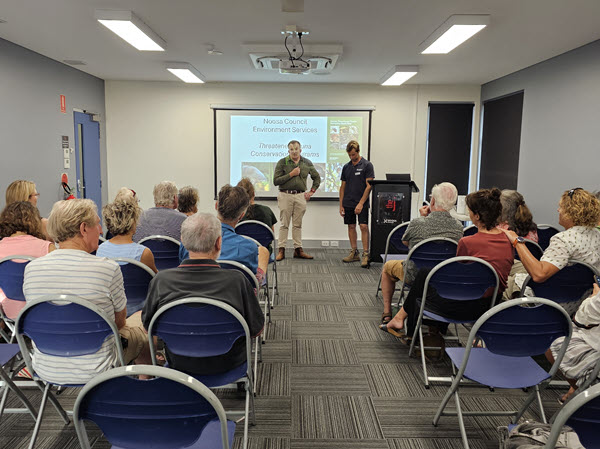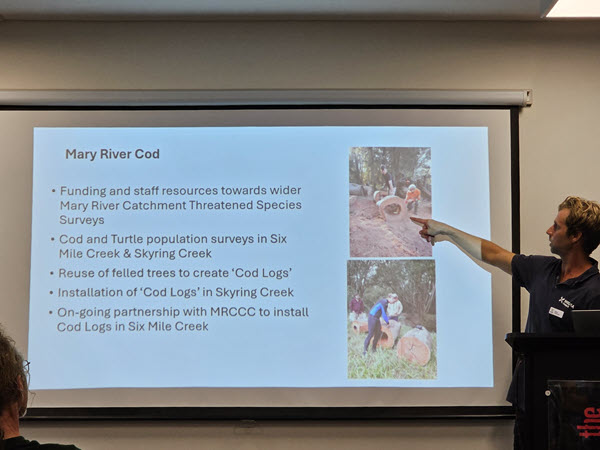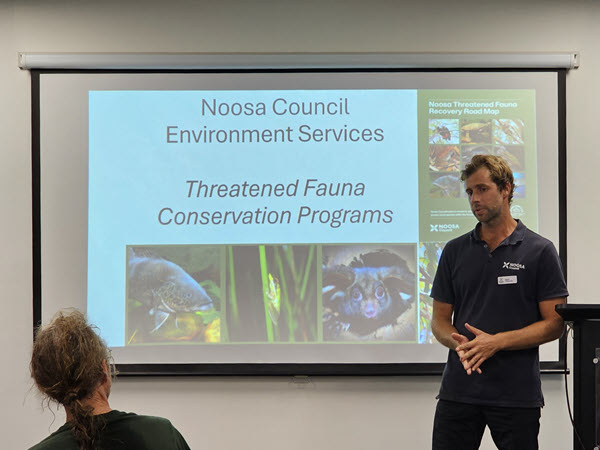
At our UWG November Workshop, Noosa Council Officer Dave O’Gorman presented the Noosa Threatened Fauna Recovery Road Map. This Road Map was developed to facilitate and guide the on-going management and recovery of threatened fauna across the Noosa Shire and our adjacent coastal waters. The project, with an expert panel, identified the ‘Noosa Nine’ for conservation priority for different ecosystems in Noosa and ensures the net improvement of local biodiversity. The expert panel scored species against a range of threatening processes (such as climate change, development and land use practices), and listed the following species for conservation priority:
Giant Barred Frog (Mixophyes iteratus)
Glossy Black Cockatoo (Calyptorhynchus lathami)
Greater Glider (Petauroides polans)
Koala (Phascolarctos cinereus)
Tusked Frog (Adelotus brevis)
Mary River Turtle (Elusor macrurus) and Mary River cod (Maccullochella mariensis)
Acid Frogs (Wallum Froglet, Rocket Frog and Sedge Frog)
Water Mouse (Xeromys myoides)
David presented information about these species and some practices that can be undertaken by urban gardeners to assist conservation efforts. Key points included the amount of work still to be undertaken by Council and the community to understand and secure the future of the 9 listed species. More information about the road map can be found on Council’s website at: https://www.noosa.qld.gov.au/Environment-and-Waste/Environment/Trees-plants-and-animals/Threatened-fauna-recovery
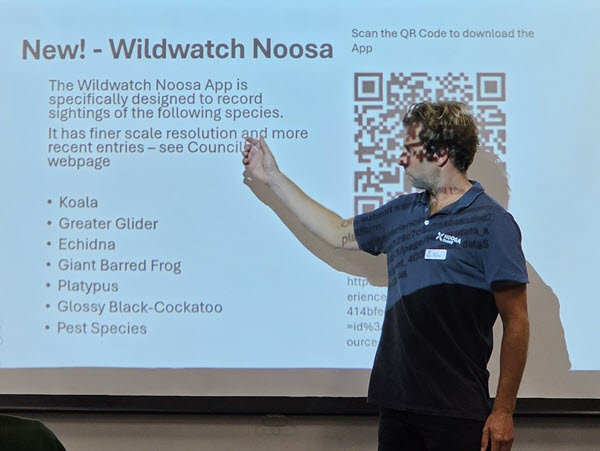
A key point of discussion at the workshop was the use of the ‘Wildwatch Noosa’ platform as compared to the well known ‘iNaturalist’ platform to record details of species.
‘Wildwatch Noosa’ was developed specifically for Noosa and focuses on the threatened species roadmap. Data gathered on this platform enables the community to capture observations for a selection of both native animals and feral species that are significant to the region. By working together to capture data about the location and health of our local wildlife, it enables Council and the community to better understand their habitats and threats, helps to identify priority areas for conservation and rehabilitation efforts, and better inform programs for management of feral species. More information about the platform, including links to the web platform and an app, is available at: https://www.noosa.qld.gov.au/Environment-and-Waste/Environment/Trees-plants-and-animals/Wildlife-Sightings-Submissions (I think the web platform is a more simple interface than the app). Data is also made available to the Queensland Government Wildnet Platform to inform government decisions, effective planning, scientific advancement and better conservation results. The Wildnet Platform is available at: https://www.qld.gov.au/environment/plants-animals/species-information/wildnet.
The ‘iNaturalist’ platform is a crowdsourced international citizen science species identification system and an organism occurrence recording tool. It can be used to record your own observations, get help with identifications, collaborate with others to collect this kind of information for a common purpose, or access the observational data collected by iNaturalist users. The platform is based in the United States and is non-for-profit. The platform states that at its core, iNaturalist is an online social network of people sharing biodiversity information to help each other learn about nature. More information is available at: https://www.inaturalist.org/
The workshop received good feedback about the timing (mid week evening) and the convenience of the venue (the J) and the UWG Committee will keep this in mind for future workshops and presentations in 2026!
Shaun Walsh