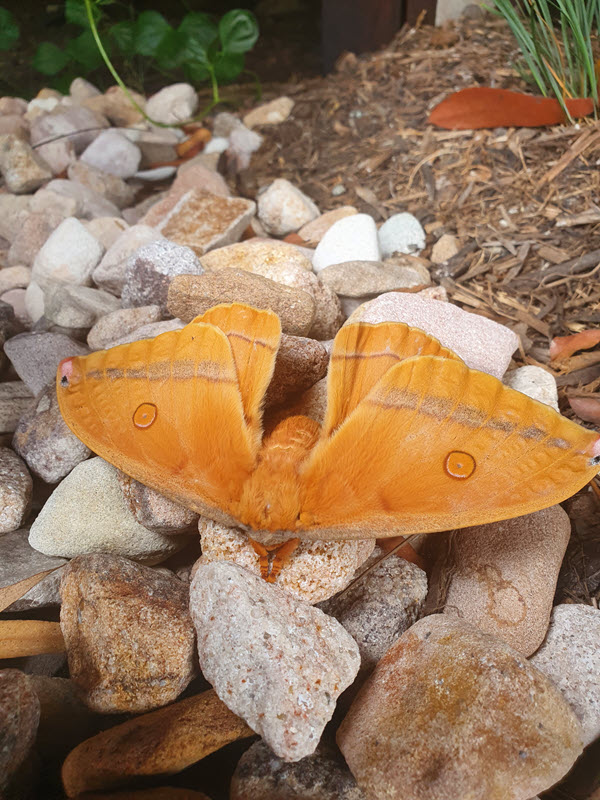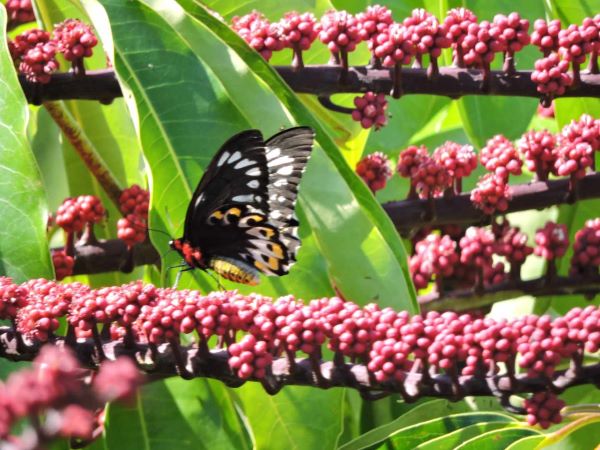
Here in Southeast Queensland, we are lucky to have a region of diverse habitats which support hundreds of species of moths and butterflies both of which belong to the order of Lepidoptera, meaning ‘scaled wings’. Lepidoptera is one of the largest insect orders in the world with at least 160,000 species worldwide.
Butterflies are a subset of moths within the order of Lepidoptera, belonging to the suborder Rhopalocera while moths are generally grouped as Heterocera. There are far more moth species than butterflies. Both species undergo complete metamorphosis from egg to larva (caterpillar) to pupa to adult with many caterpillars being host specific, feeding on only certain native plants.
What are the major differences between these insects? Butterflies are day-active, relying on external heat (sunlight) to fly, and can be spotted basking in the sun. Moths can generate and retain heat more effectively, due to their thicker, hairier bodies complementing their nocturnal habits, and making them more adaptable in cooler conditions. Some moths able to vibrate their flight muscles to warm up before take off! Butterflies use aposematism or ‘don’t eat me’ signals in the form of bright colours, bold patterns and sometimes smells or sound to scare off predators. For example, the Common Crow species often found in SEQ, stores toxins from plants as a caterpillar and has dark wings with white spots to deter predators as a butterfly. Moths on the other hand have developed their own defence system, commonly featuring ultrasound detection and erratic flight patterns, with some species producing clicking sounds to confuse bat echolocation. Moths often have a wing coupling system (frenulum) that links forewings and hindwings for stability. Moths belonging to Sphingidae are able to hover like a hummingbird whilst feeding. Butterflies lack this characteistic and rely on synchronous wing movement for flight.
The life cycles of these two critters also differ slightly. Butterflies are selective with host plants on which to carefully and individually lay their eggs, choosing exact leaf surfaces for optimal survival. Moths do not play by the same precise rules with eggs often found in large clusters and their placement less dependent on the plant species.
As caterpillars, butterflies are smooth and brightly coloured whilst moths are hairy and spiny, yet better camouflaged. Once caterpillars have plumped up on your precious garden plants, butterflies form a chrysalis which is often hard and exposed whilst moths spin a cocoon enclosing the pupa entirely and forming a protective and insulative barrier to the outside environment. The silk production of butterflies is minimal and mainly used for attaching the chrysalis, whilst certain species of moth, such as the Bombyx mori silkworm, produce silk on a commercial level and love a good mulberry tree. Once they have graduated from the pupal period, 1 – 3 weeks for butterflies and 2 – 6 weeks for moths, these insects continue on different paths with butterflies on the hunt for bright, vibrant flowers and moths choosing to visit pale, scented flowers at night.
Both species are responsible for high rates of pollination in our region and are an excellent indicator of the state of health of your local ecosystem. Whilst we might appreciate these critters, specifically the butterfly in their flight stage (the moth not so much as it flies into your exterior light repetitively), and curse them in their destructive caterpillar phase, they are an essential food source for reptiles, birds, bats and small mammals and play an essential role in your home garden.
Samuel Wockner