We all know the familiar sound “click, click, click” in rapid succession, often heard but not seen from dawn until dusk, but once the bugs are out these nocturnal hunters are on the prowl and can become quite vocal and be a regular visitor to the patio, it is of course the Gecko! Pleasant to the eye these soft-skinned lizards belong to the Gekkonidae family, known for their sticky toe pads, large eyes with vertical pupils (adaptation for night vision) and ability to lick their eyes clean as they lack movable eyelids. These hunters of the night are often spotted on exterior or interior walls near a light source attracting prey in the form of moths, mosquitoes and midges. They can be out in numbers on hot, humid nights and will compete aggressively for prime feeding spots. You may have witnessed these entertaining critters, but have you ever wondered if they are native to your backyard or perhaps an escaped convict?
It is most likely the invasive Asian House Gecko (Hemidactylus frenatus) that you have spotted in and around your home, now widely established throughout SE QLD, first spotted in Brisbane in the early 1980s. Typically 7.5 to 15cm long their colour ranges from pale grey/brown to slight green iridescence, changing slightly dependent on the background colour. Their main ID feature are tiny spines along the back and tail which the native gecko lacks. Originally ‘tree-dwellers’ these imposters have adapted to urban environments and are now one of Australia’s most abundant reptiles, with populations extending from the Kimberley region in Western Australia across the Northern Territory into Far North Queensland down to Coffs Harbour (NSW), with populations recorded on Norfolk Island! Although these resilient bug controllers may not come across as a pest, they can displace native gecko populations by outcompeting them for food and dominating in sheer numbers due to their ability to breed year-round in tropical regions.
What about the good guys? The Native Gecko (Dubious dtella) also known as Gehyra dubia can be found in every state in Australia except for Tasmania, similar size to the Asian House Gecko, 6 to 14cm with their main habitat composing of woodlands and dry forests, although also being found around houses at night. They are generally dull brown to grey with darker spots and a smooth body and tail, with a slight camouflage ability to change to a lighter brown. Their dietary requirements differ slightly, preferring larger invertebrates such as spiders, cockroaches, scorpions and beetles also known to feed on plant sap and nectar as well. They prefer darker corners and have a lighter chirp to that of the Asian House Gecko. Females will lay small clutches (often two eggs) with breeding tied to the warmer months.
There is ongoing research into the effect of Hemidactylus frenatus (Asian House Gecko) on our native friends Dubious dtella, with ongoing studies suggesting they could pose risk of indirect ecological effects carrying mites or parasites with the main risk being habitat displacement and domination due to their aggressive breeding and feeding habitat. Their eggs are unusually tough, resistant to desiccation and spreading globally through international cargo and shipping.
Both species provide for natural entertainment on a hot summer’s night, filling the quietness with sounds of clicking as they scatter around and defend their chosen ambush spot. With eyes 350 times more sensitive than human eyes in the dark, bugs unlucky enough to fly within striking distance do not stand much of a chance against these brutal night-time predators.
Samuel Wockner
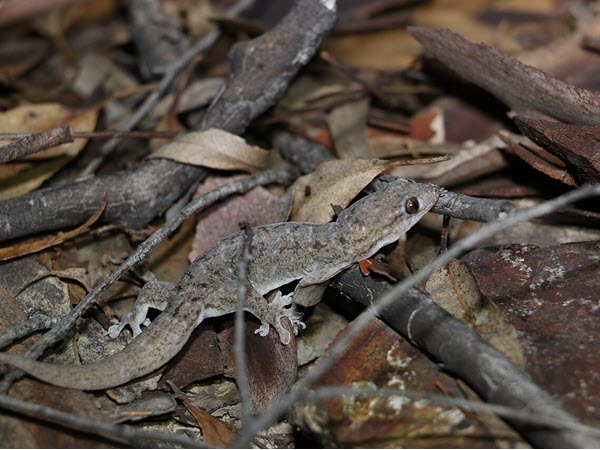
The Native Gecko (Dubious dtella) by Greg Tasney – https://www.inaturalist.org/photos/186535759, CC BY-SA 4.0, https://commons.wikimedia.org/w/index.php?curid=120623105