Many urban gardeners in Noosa desire hedges, often in narrow garden beds, to provide screening and soften surrounding fences. Can you have a hedge that also contributes to biodiversity and wildlife?
The ‘go-to’ native plant for hedges are Lillypillies (Syzygium spp.) After planting them, many gardeners realise that this large, fast growing rainforest tree requires constant pruning to keep it in a smaller hedge shape. Lillypillies can also get leggy and are often prone to Psyllid attack (jumping plant lice) that repeatedly deforms the foliage.
What other plants are suited to hedges in urban wildlife gardens in Noosa? Here are 6 alternatives worth considering.
Coastal Cypress – Callitris columellaris
Callistrus species are some of the most superior hedging species available. They are from the Conifer family and evoke the exotic cypress but are much better suited to local conditions. The local Callitris columellaris (Coastal Cypress) is a relatively slow growing species that has feathery foliage which shapes beautifully. It loves coastal conditions and sandy soils, but I find it also grows well in clay if it is on a raised bed to assist drainage. It needs a light prune only a few times per year to maintain its shape, and the soft aromatic foliage is a delight to work with. I find smaller birds such as mistletoe birds love to nest in its dense foliage.
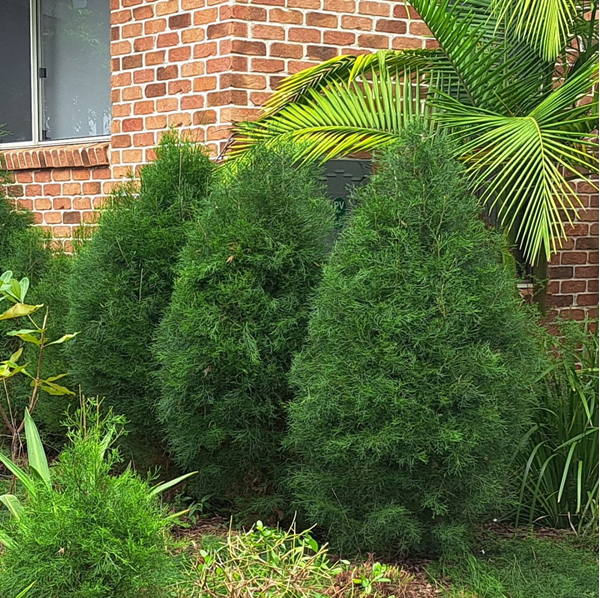
Photo: Shaun Walsh
Beach Birds Eye – Alectryon coriaceous
Beach Birds Eye is another great native coastal plant that prunes beautifully as a hedge, with attractive large veined foliage a real delight. You can keep it tightly pruned to shape but, if you delay pruning, the cream flowers are attractive. The subsequent masses of shiny black fruit enclosed in a red aril attract fruit-eating birds. So, I recommend pruning back to shape after fruiting.
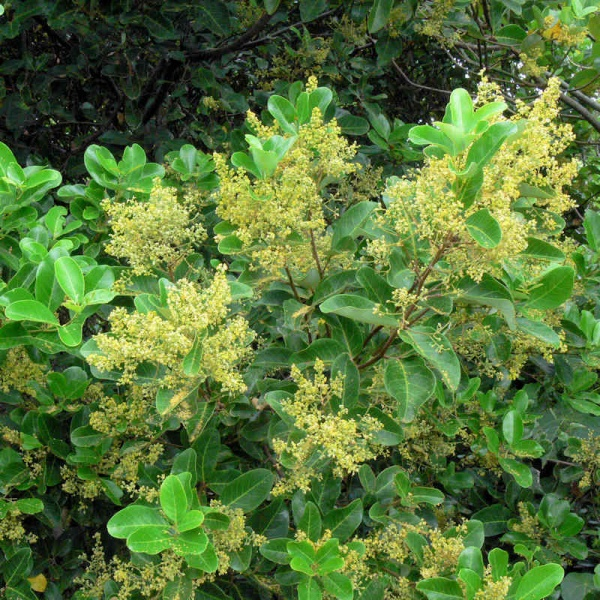
Photo from www.noosanativeplants.com.au
Fraser Island (Kgari) Apple – Acronychia imperforata
This is another native coastal plant that makes a great hedge. The Fraser Island (Kgari) Apple is a tidy shrub with attractive glossy green foliage, cream flowers and edible but sour fruit.
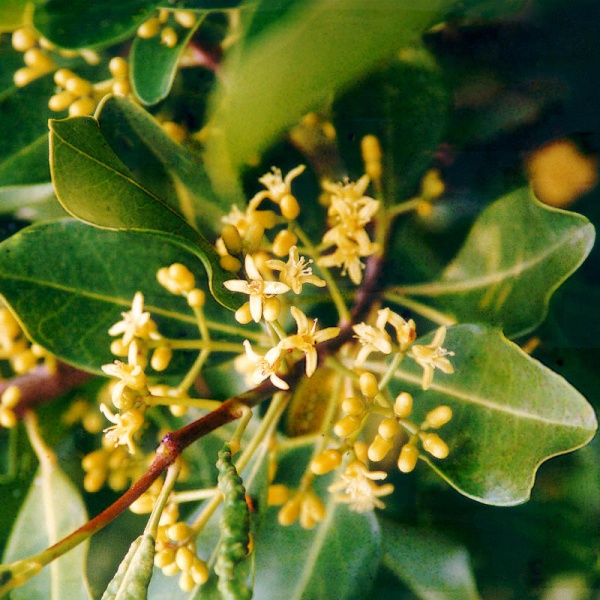
Photo from www.noosanativeplants.com.au
Snow in Summer – Melaleuca linariifolia
This shrub has narrow foliage with greyish tones and beautiful cream flowers attractive to honeyeater birds. It clips beautifully and red flushes of new growth are attractive as well. It is suited to both sandy soils of the coast and clay soils of the hinterland provided it has good moisture. There are some good examples near to the driveway entry to the Cooroy Train Station on Elm Street which are neatly clipped and provide an excellent hedge.
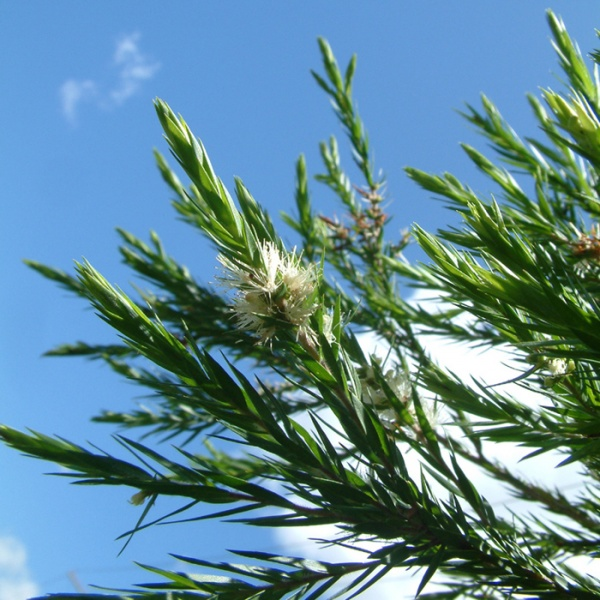
Photo from www.noosanativeplants.com.au
Brown Pine – Podocarpus elatus
Podocarpus is one of the most widely distributed conifer genera on earth, occuring across tropical and subtropical continents. It is also one of the most renowned hedging species of horticulture and we are very fortunate to have the local Brown Pine in Noosa. This is a very slow growing plant that will take 4 to 5 years to achieve hedge height, but then you will be rewarded with a hedge that only occasionally requires pruning. The narrow vertical leaves also provide the most precise hedge box shape suited to formal gardens. This plant is for hinterland locations on clay soils with reliable moisture. Its fruit attracts Currawongs and other fruit eating birds.
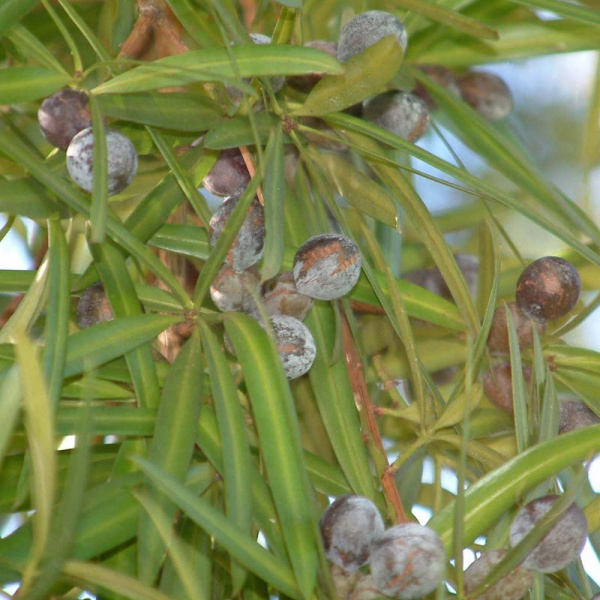
Photo from www.noosanativeplants.com.au
Finger Lime / Gympie Lime – Citrus australis or Citrus australasica
The Native Finger Lime, and its close relation the Gympie Lime, both make a fine hedge when in full sun with good moisture and nutrients and drainage. You will be rewarded with one of the best bush foods with the beautifully flavoured and coloured fruit, but will require protective clothing to harvest and prune due to the thorns. It is an excellent plant for deterring intruders! This shrub is very attractive to Swallowtail Butterflies. Don’t be afraid to prune the plant when young, to force a bushy shape, as well as after fruiting.
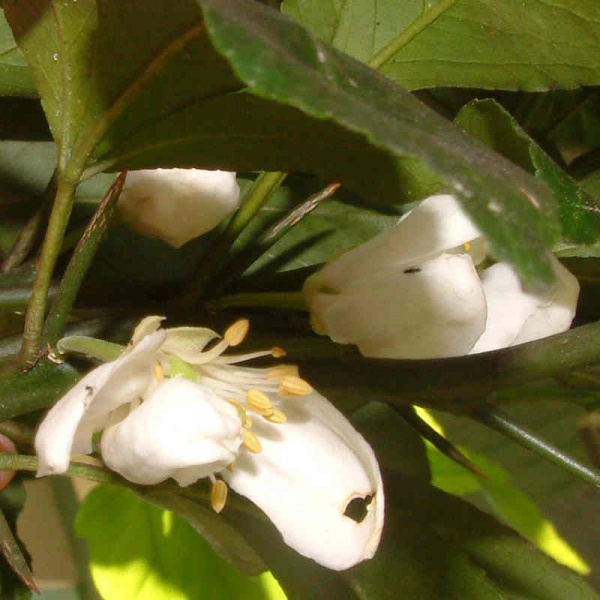
Photo from www.noosanativeplants.com.au
Trellis Plants – Another Option
Another option to hedges, particularly in narrow spaces, is to build and plant a trellis. Our local rainforest vines are ideal to provide screening and flowers. Options with both dense foliage and good flowers include:
Bower of Beauty – Pandorea jasminoides
Native Wisteria – Callerya megasperma
Fraser Island Creeper – Tecomanthe hillii
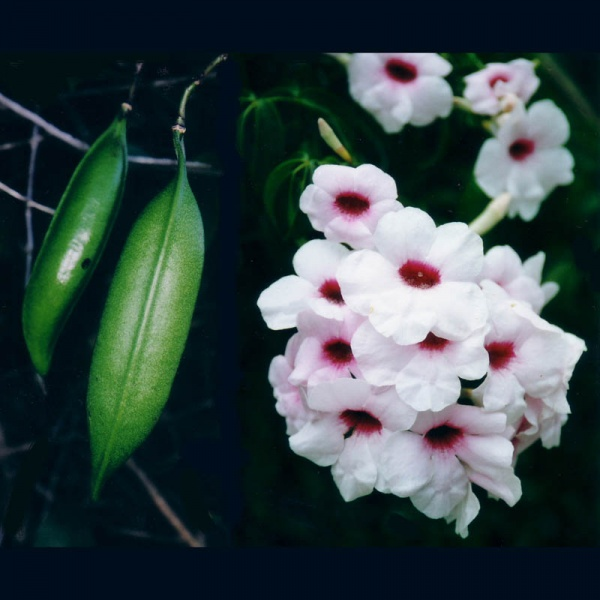
Photo of Pandorea jasminoides from www.noosanativeplants.com.au
Shaun Walsh